Pre-Trade Risk
Pre-trade risk metrics and methodology.
The Tool
Risk control with an intuitive, agile, and highly efficient experience.
Base provides an advanced pre-trade risk limit management platform, designed to offer visibility, control, and agility in decision-making.
With access via a web interface and full API integration, the solution enables continuous, real-time monitoring, ensuring every operation aligns with defined limits. Intuitive navigation simplifies profile management and reduces operational complexity.
Furthermore, the platform offers a direct channel for tracking requests and support, combining operational autonomy with expert assistance whenever needed.
Greater control, greater integrity, greater security — right from the start of every trade.
Specification
Metodologia completa de risco pré-negociação.
Critical Path
Maximum Buy/Sell Order Size: maximum financial volume for a buy or sell order in a given instrument.
Potential short or long balance per instrument: limits asset exposure by accounting for executed trades and order book entries. Set by the Exchange for each instrument, this limit can be adjusted (reduced) by participants for their clients.
Global Metrics
Potential Debit Balance: controls the aggregate financial balance to be settled, ensuring it aligns with the client's financial capacity. This metric evaluates trades executed during the session and open orders in the order book.
Potential Short Sale Balance: limits the potential financial volume of short sales. This metric evaluates trades executed during the session and open orders in the order book.
Day-Trade Financial Balance: limits the financial loss from operations executed during the session.
Breaches
Critical path metrics: if a critical path metric is breached, the order is rejected.
Global metrics: if a global metric is breached, the entity responsible for the breach enters protected mode, allowing only for position reduction.
Blocked Mode
When blocked mode is activated, it will not be possible to submit new orders, even for position reduction.
Summary

Critical Path
• Maximum Buy/Sell Order Size (TMOC/TMOV)
• Potential Buy/Sell Balance per Instrument (SPCI/SPVI)
• Authorized Market (MKTA)
Aggregate Metrics
• Potential Debit Balance (SDP)
• Potential Short Sale Balance (SPVD)
• Day-Trade Financial Balance (SFD)
Protected Mode
Potential balance per instrument (SPI)
Blocked Mode
Blocks new orders
Architecture
Robust architecture, real-time performance.
Base's pre-trade risk limit solution is built on a modern, scalable, and highly efficient architecture designed to support critical decision-making. By integrating multiple layers of validation, processing, and monitoring, the system ensures low latency and high availability, even during periods of high operational volume.
This structure enables the consistent application of risk rules and metrics throughout the entire workflow, ensuring rigorous control without compromising the agility required in a trading environment.
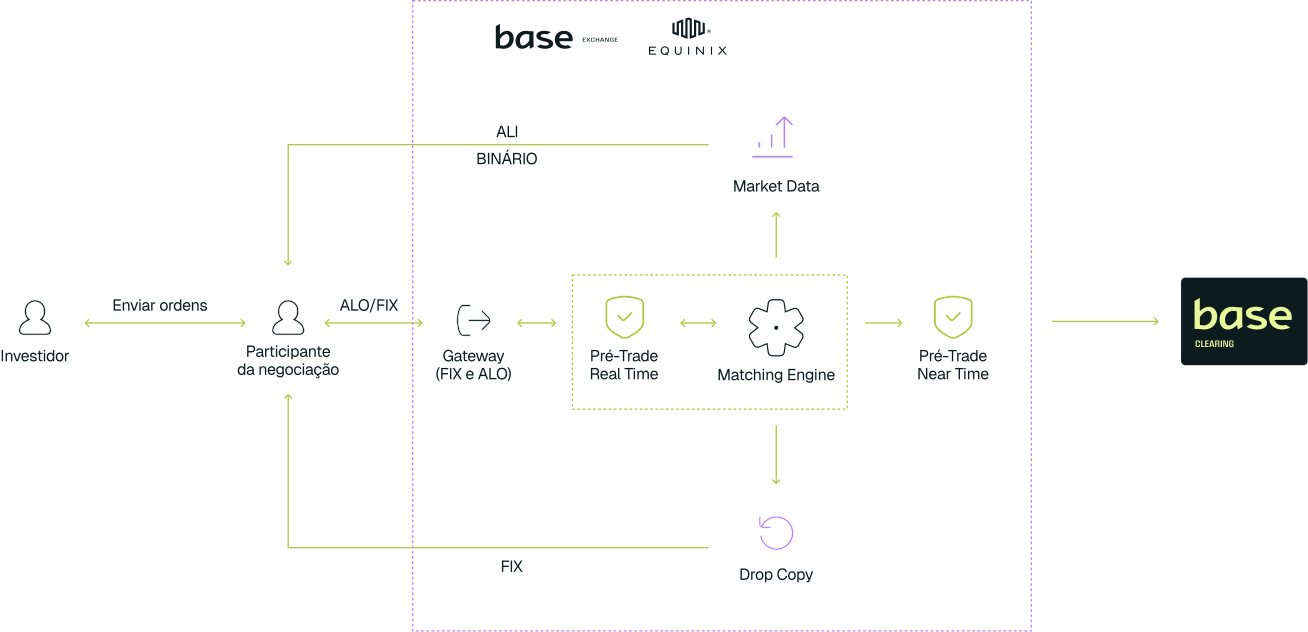

Communication protocol for receiving order and trade messages.
Order entry protocols used by Base.
Base's proprietary protocol for market data distribution.
Clearinghouse responsible for post trade.
Entry point for orders into Base's trading environment.
Core trading component responsible for processing and executing orders.
Post-Trade Risk
Collateralization methods and calculation modules
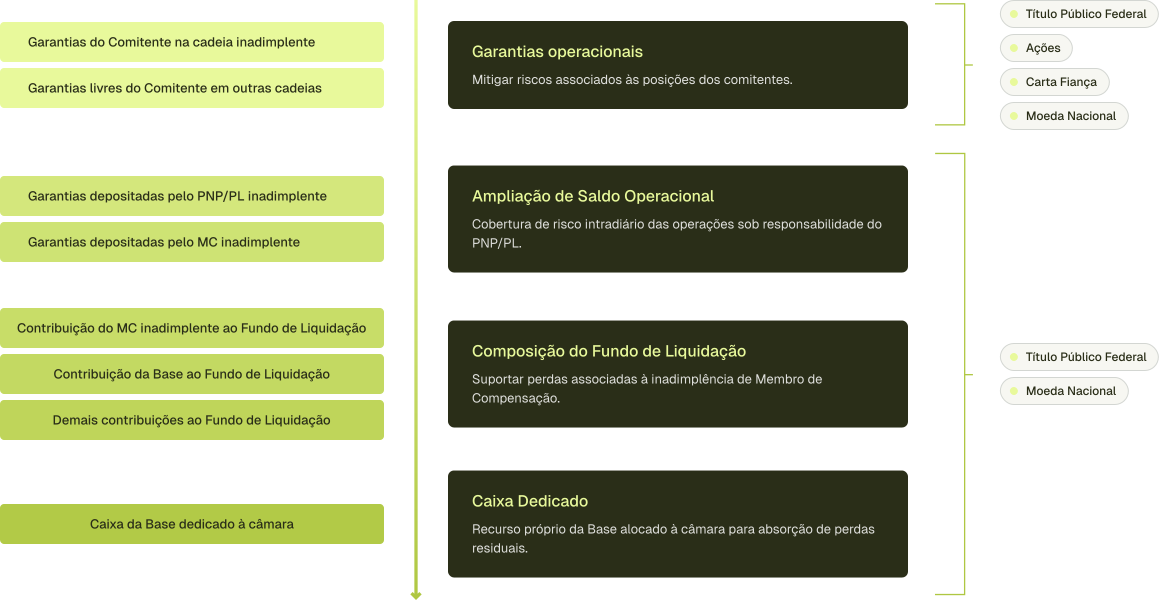
Risk exposures for spot market positions can be collateralized by the investor or by the Participant (Full Trading Participant – PNP or Settlement Participant – PL). In the risk system, the OP module calculates margin requirements for positions collateralized by investors, while the CP and NAC modules provide an integrated view of exposures and any margin requirements for PNPs and PLs, respectively, for the following purposes:
Operational Collateral
Refers to the purpose of the collateral provided to support the risk of positions calculated by the OP module, for which the investor is responsible for collateralization.
• OP calculation module
Operating Balance Expansion
Refers to the purpose of collateral provided to cover the risk calculated by the CP (spot market positions collateralized by the Participant) and NAC (unallocated positions) modules, for which collateralization is the responsibility of the PNP/PL.
• CP calculation module
• NAC calculation module
As a complementary layer of robustness to the safeguard structure, Base and the Clearing Members must contribute resources for the following purpose:
Default Fund
Refers to the purpose of collateral provided to cover the residual risks of Participants in more severe scenarios, for which collateralization is the responsibility of Base and the Clearing Members.
This segmentation enables financial risk to be mitigated with precision and efficiency, allocating capital across multiple layers — from the investor to the Clearinghouse — within a clear Responsibility Chain. Collateral requirements are distributed according to the exposures and responsibilities of each participant.
Risk model
At Base Clearing, risk management is integrated and continuous: our model identifies, measures, and monitors the market, credit, and liquidity risks inherent to the Clearinghouse's role as a Central Counterparty (CCP). Developed in compliance with regulatory requirements and aligned with international best practices, the model allows for the sizing of margins and collateral in a manner consistent with the risk profile of each participant and their portfolios, promoting security, efficiency, and resilience in the clearing and settlement process.
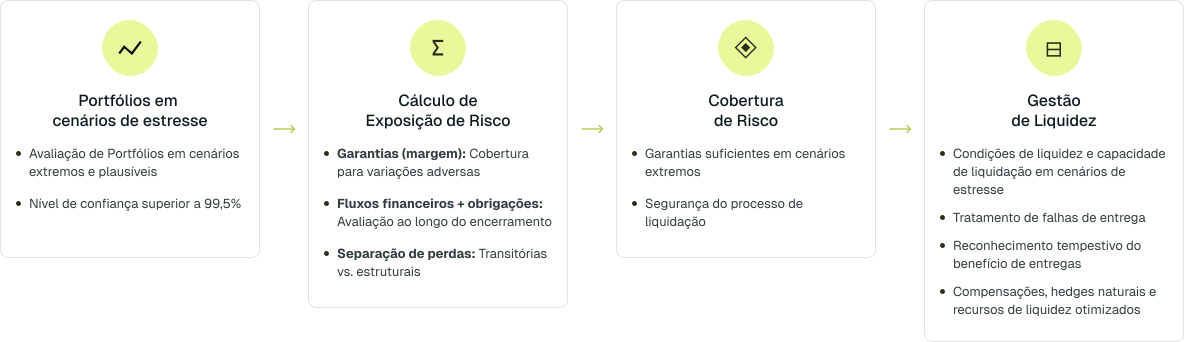
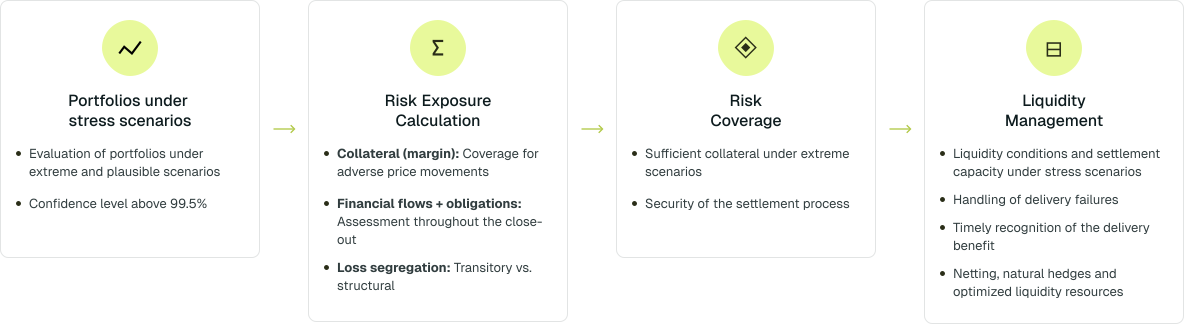
Integrated Monitoring
Performed both intraday, for operational balance control, and on a daily basis, for the calculation of required margins.
Comprehensive Safeguards
Settlement Fund, dedicated proprietary cash, daily stress testing and backtesting with independent validations to ensure the robustness of the Clearing House even in the event of a default by the two largest Clearing Members, together with their economic groups under extreme scenarios (Cover2)
Robust Model
Combines quantitative rigor, prudential assumptions, and continuous monitoring.
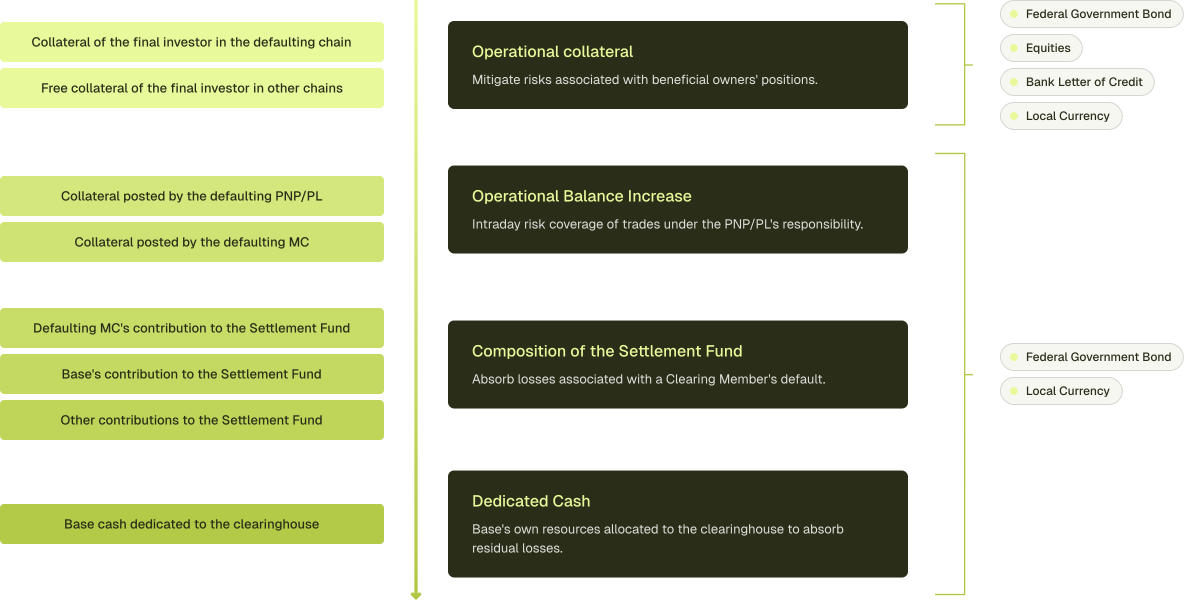
Safeguard Structure
Base employs a robust safeguard structure, organized into multiple layers of protection to ensure efficient loss absorption and operational continuity, even in adverse scenarios.
This architecture combines participant collateral, mutualized resources, and additional mitigation mechanisms, forming a resilient model aligned with international best practices.
Each component of the structure works in an integrated manner, ensuring predictability, transparency, and confidence throughout the entire settlement cycle, reinforcing the strength and security of the trading environment.
In the event of a default, the order of collateral utilization is:
Collateral
Risk structure and coverage
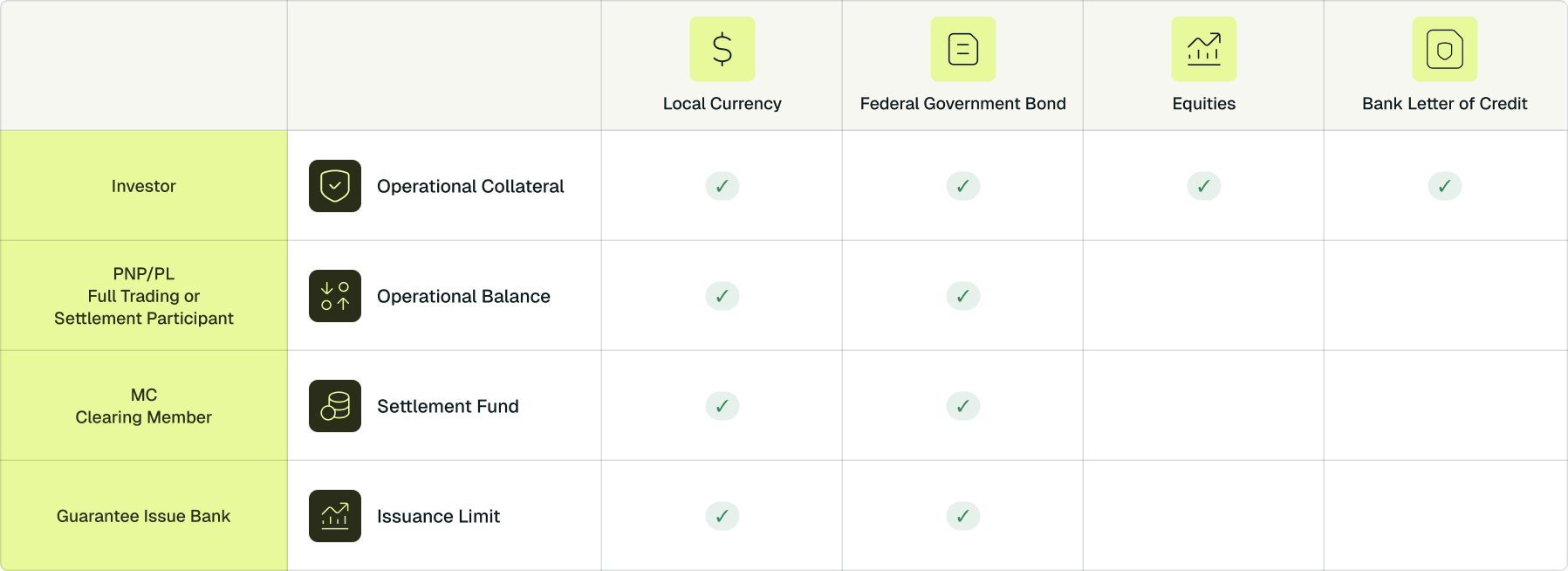
Eligible collateral by purpose
Clarity and structure for every trade.
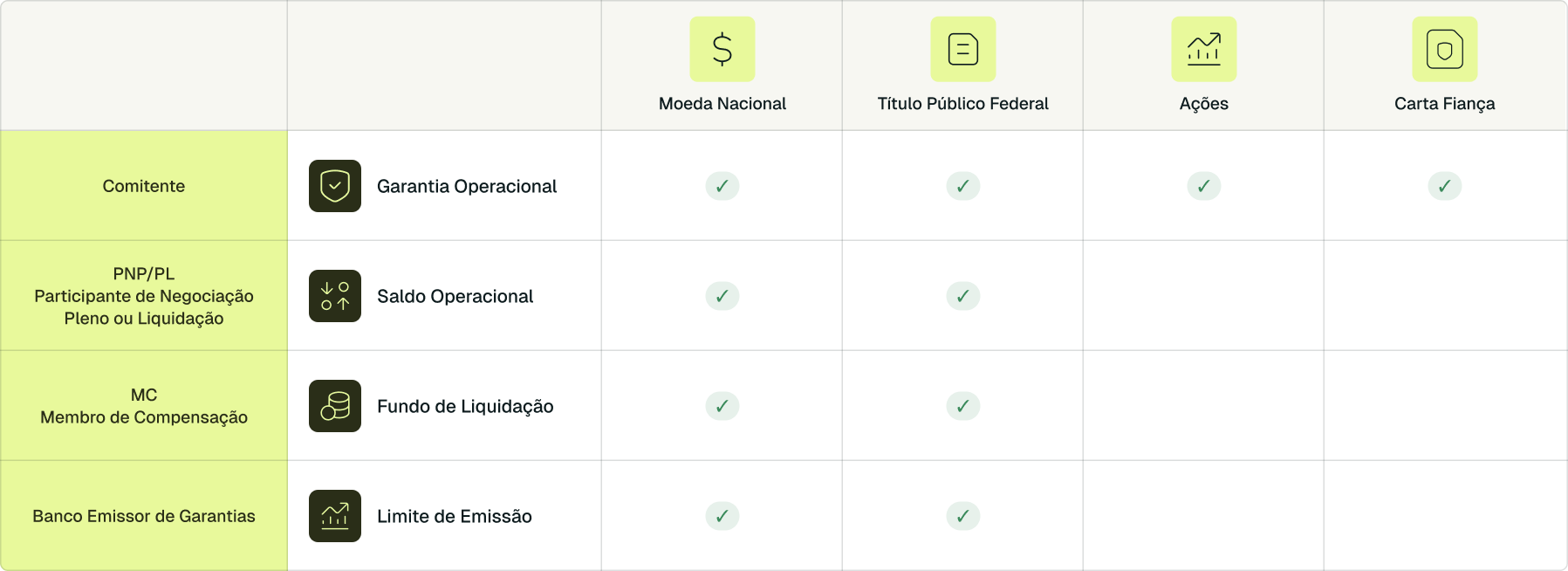
Collateral eligible at Base is organized by deposit type and detailed to facilitate planning and efficient management.
The table below presents the complete list, providing a clear view of the assets eligible for each operational context.
Accepted collateral
Continuous transparency and dynamic updates.
Base provides the complete list of accepted collateral, structured to ensure clarity and consistency in collateral management. This list is updated monthly, or on an ad-hoc basis when necessary, with prior notice always provided to participants.
The acceptance limits applicable to each asset class are disclosed on this same page, ensuring full transparency regarding the criteria used.


List of accepted instruments and their respective acceptance limits by economic group.
Deposited Collateral
View the composition of collateral deposited with the Clearinghouse, organized by asset type. Consolidating this information makes it easier to monitor the distribution and concentration of the collateral used.
Schedule
The schedule outlines the key processes related to warranties, including times, operational windows, and dependencies throughout the cycle.
Parameter
Offer Features
7:30 AM
Collateral System opening.
Start of monitoring for compliance with Margin Calls resulting from the previous business day's close.
Start of the period for collateral withdrawal requests.
Start of monitoring for compliance with Margin Calls issued during the day.
2:30 PM
Deadline for depositing collateral to meet:
(i) Margin Calls resulting from the previous business day's close; and
(ii) Margin Calls issued by 2:30 PM.
5:00 PM
Deadline for moving collateral in national currency.
8:00 PM
Deadline for moving collateral in national currency.
8:15 PM
Deadline for moving collateral in federal government bonds.
8:30 PM
Collateral System closing.


