services
/
Trading
The stage where our systems receive offers, organize them, and match buyers with sellers.
About trading
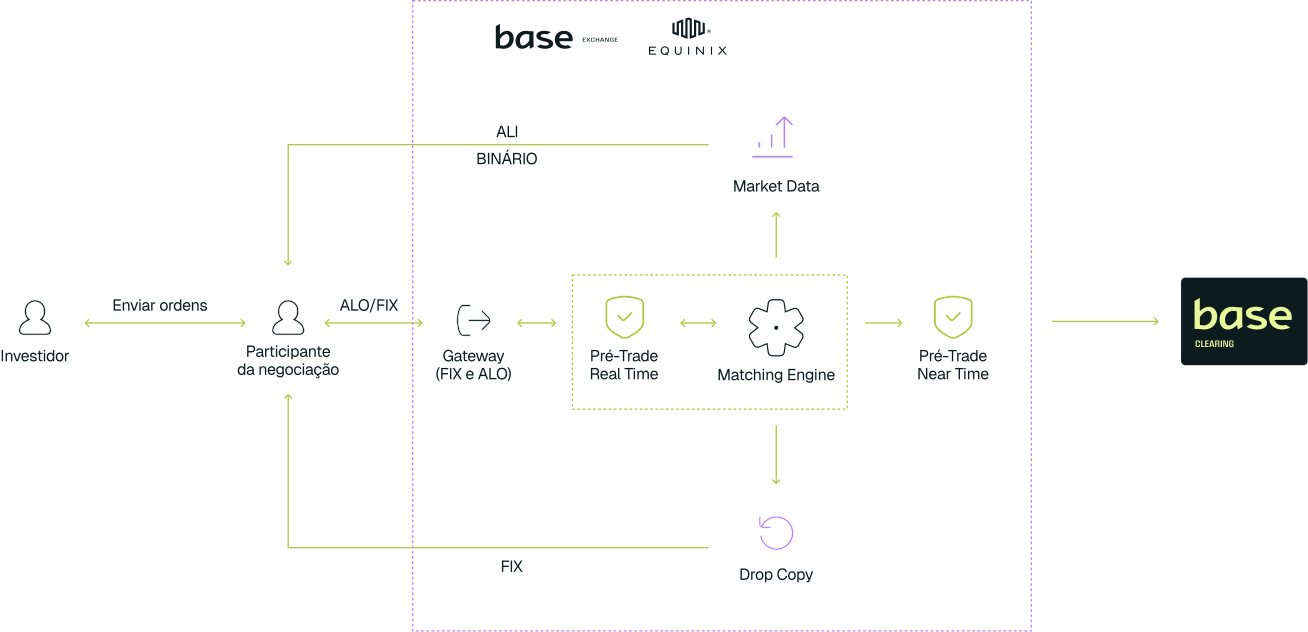
Base's trading environment was built for participants who depend on performance, predictability, and operational efficiency. The infrastructure uses proprietary technology for order entry, market data, and drop copy, with low-latency binary protocols and FIX support aligned with the standards already used in the Brazilian market. This simplifies integration for OMSs, algos, and platforms certified in the existing ecosystem.
Base also supports features widely adopted in international markets, including post-only orders, single-share lot sizes, and pre-trade risk validation. An environment suited to automated strategies, market making, and latency-sensitive operations.
How it works
Trading on Base offers a simple, fast, and transparent experience. Explore the details below to get started.
Communication protocol for receiving order and trade messages.
Order entry protocols used by Base.
Base's proprietary protocol for market data distribution.
Clearinghouse responsible for post trade.
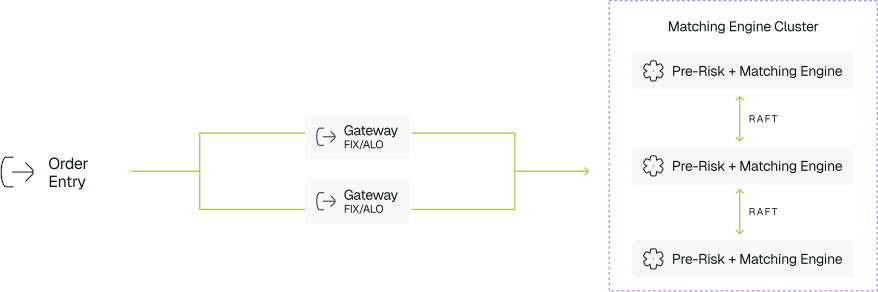
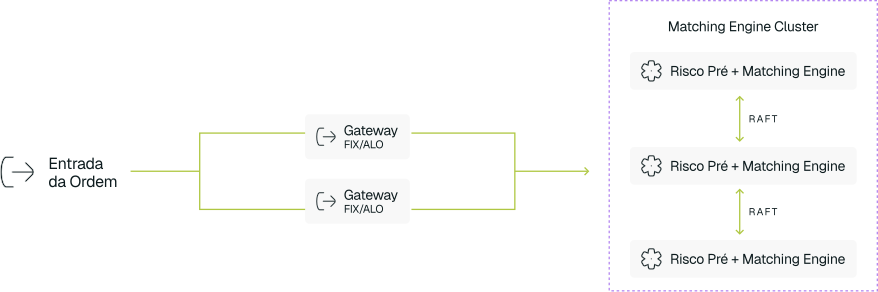
Entry point for orders into Base's trading environment.
Core trading component responsible for processing and executing orders.
Base's infrastructure is modular, with separate components for order entry, validation, matching, and Market data distribution. This architecture supports scalability, operational resilience, and straightforward participant integration. The services and components are described below.
An additional layer of risk and operational control: validates limits and risk parameters before the order reaches the book.
BASE MATCHING ENGINE
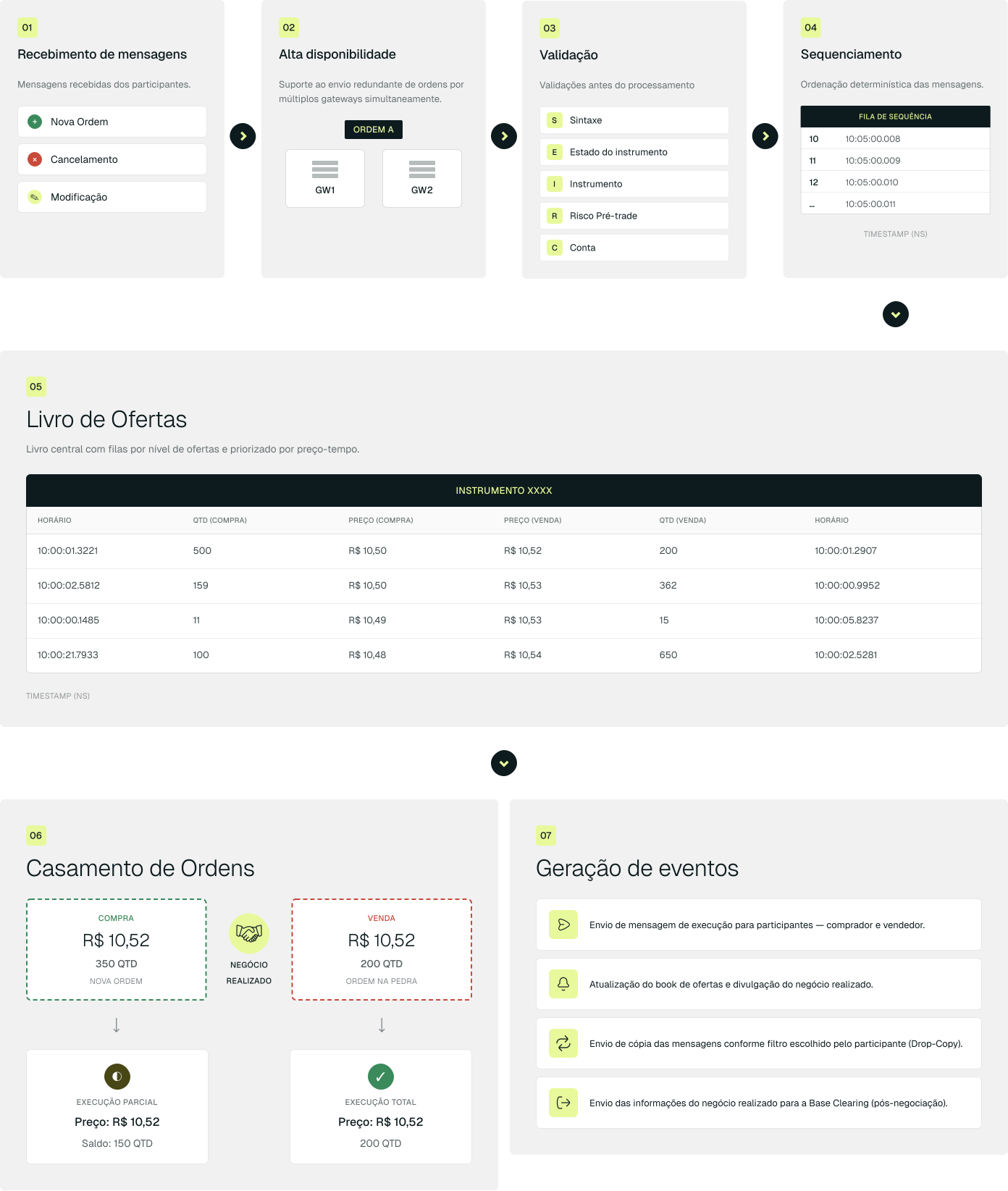
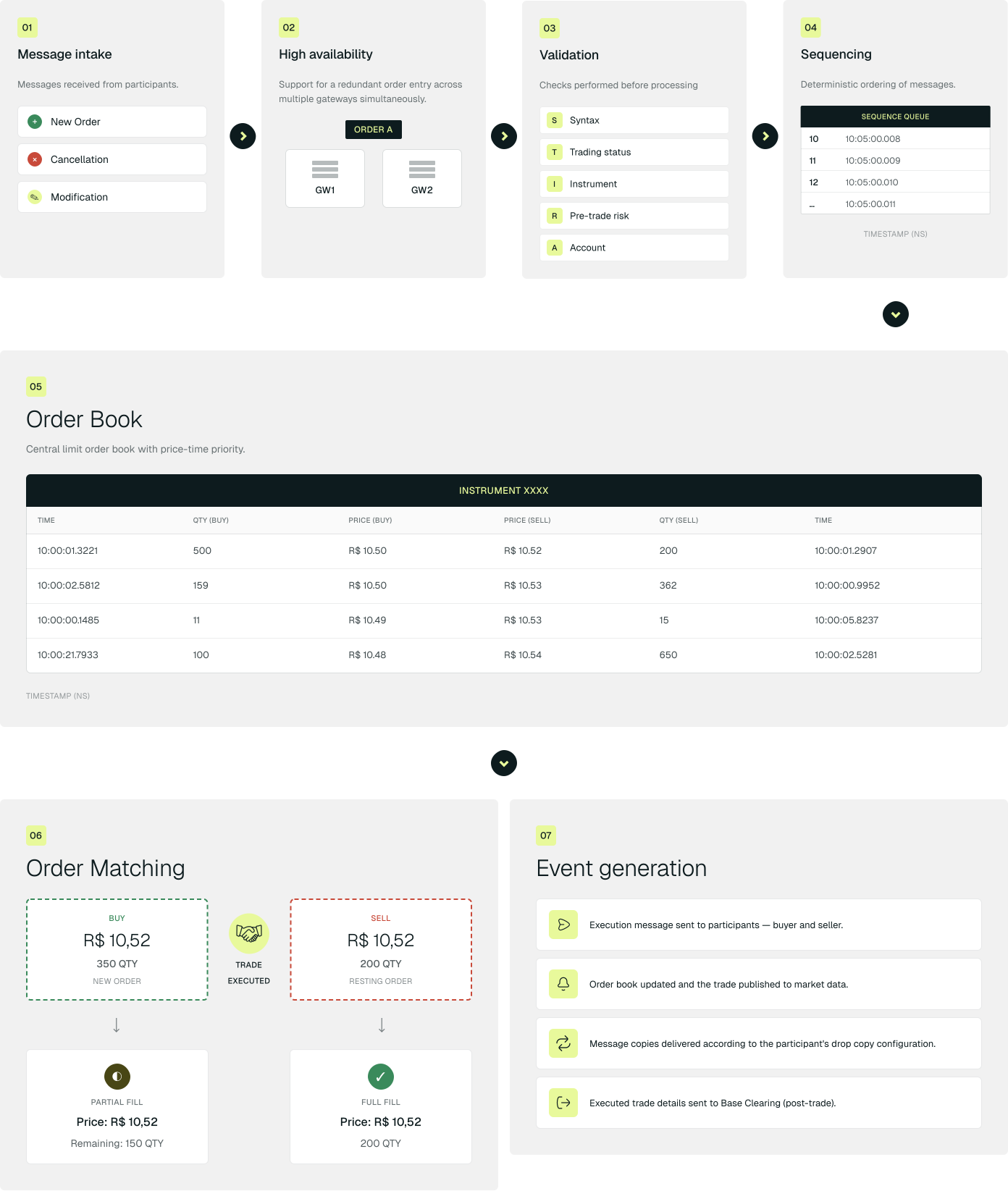
The Matching Engine is the core of the trading platform, responsible for receiving, validating, sequencing,
and executing orders sent by participants.
Built on proprietary technology, the engine matches buy and sell orders according to the trading rules defined for each instrument type, price-time priority, permitted order types, execution conditions, and market event handling.
The architecture delivers high availability, low latency, and deterministic message sequencing, ensuring predictable order processing and order book integrity.
Consensus protocol that keeps the engine instances in sync and handles automatic failover.
order types
Base provides various order types and characteristics to support different trading strategies, ensuring flexibility, control, and efficiency in the trading process.
The table below shows the main order types supported by Base and their availability by protocol.
Parameter
Order Characteristics
FIX
Binary ALO
Side
Buy or Sell
✓
✓
Type
Market: Executed immediately at the best available price.
✓
✓
Limit: Executed at the limit price or better.
✓
✓
Cross Order: Executed at a single price by the same participant representing both the buyer and the seller.
✓
✓
Validity
Day: Valid until the end of the current trading session.
✓
✓
GTC: Good Till Cancelled (valid until cancelled or fully executed, up to a maximum of 1 year).
✓
✓
GTD: Good Till Date (valid until the specified date, inclusive).
✓
✓
IOC: Immediate or Cancel (full or partial execution, with the remainder cancelled).
✓
✓
FOK: Executes in full immediately, or is canceled if there is insufficient liquidity.
✓
✓
MOC: Executed at the closing price in the Listing Market.
✓
✓
New
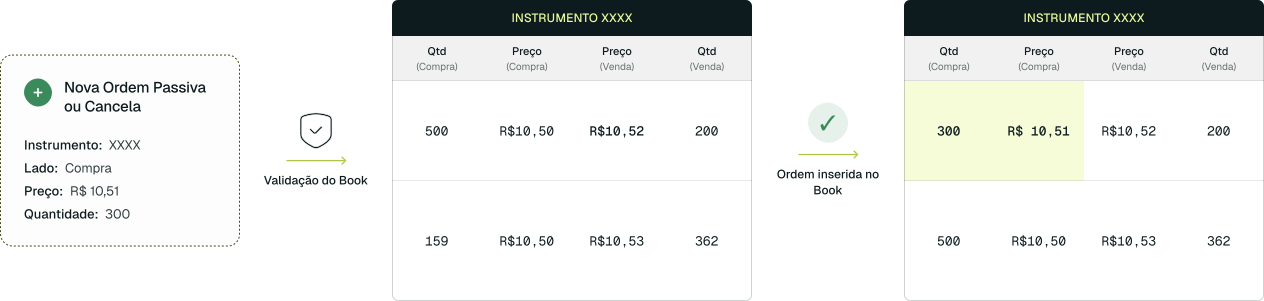
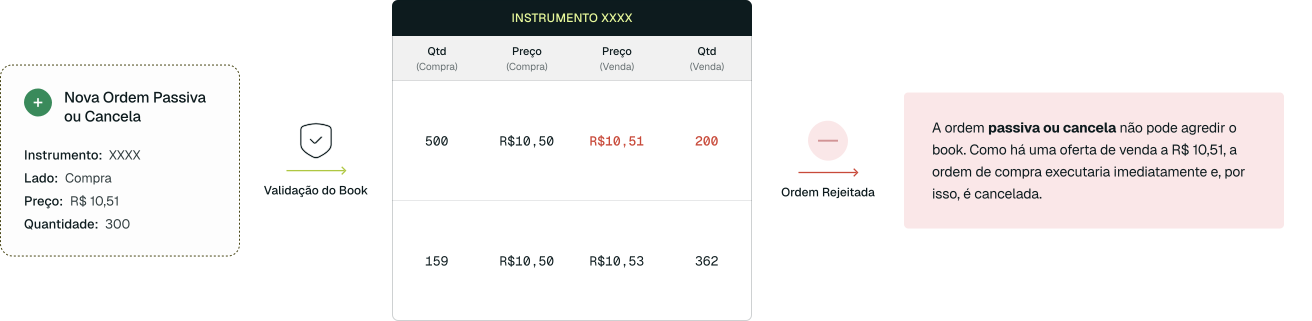
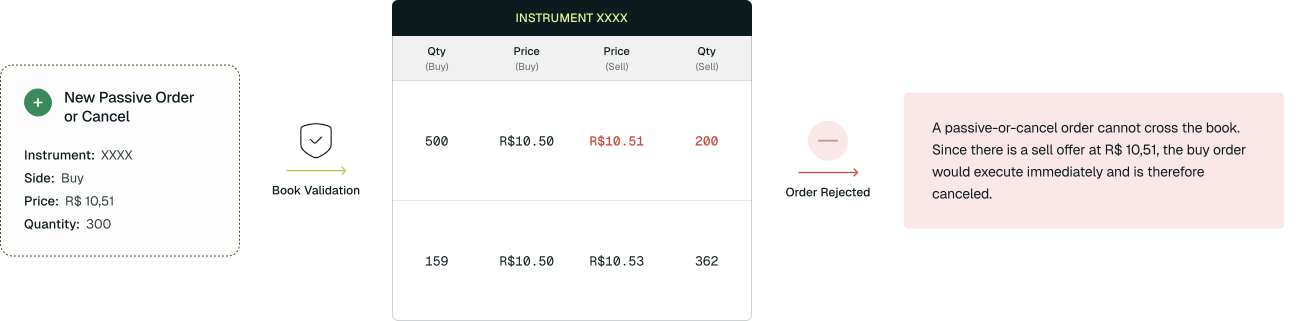
Post-Only: An order that can only add liquidity to the book. If it would execute immediately against a resting order, it is canceled.
✓
✓
Post-Only
The POC order was developed to act strictly as a liquidity provider (passive offering).
INSTRUMENT STATUS
Tradable instruments on Base carry a status disseminated in real time via market data, indicating current trading conditions for each asset. The status determines which actions are permitted: order entry, modification, cancellation, and execution, so that participants and their systems always act on the same information.
Halted
A halt is a temporary suspension of trading for an instrument, triggered by operational or regulatory conditions. While an instrument is halted, no orders are executed and only cancellations are accepted. The status is disseminated via market data, following decisions by the listing market or operational conditions at Base.
Trading
Trading is the regular session, when the market is open and processing orders. The opening is signaled via market data. During this period, order entry, modification, and cancellation are all permitted.
Tunnels and Volatility Control Mechanism
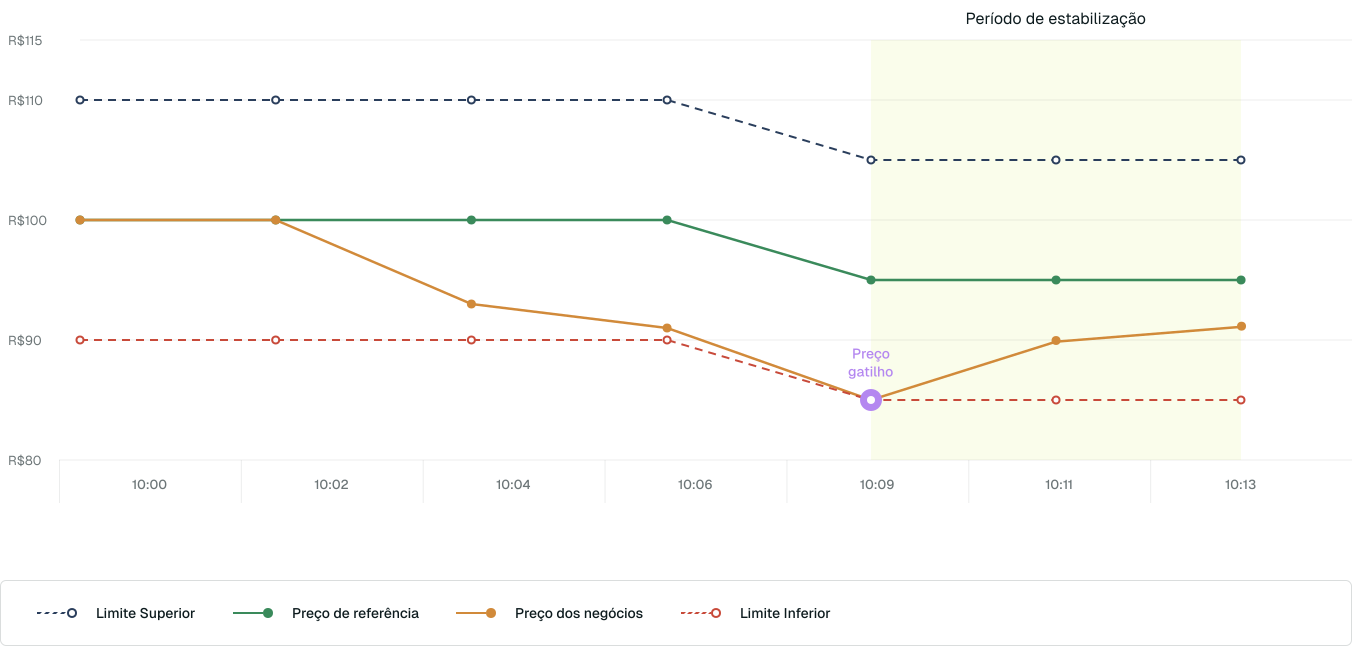
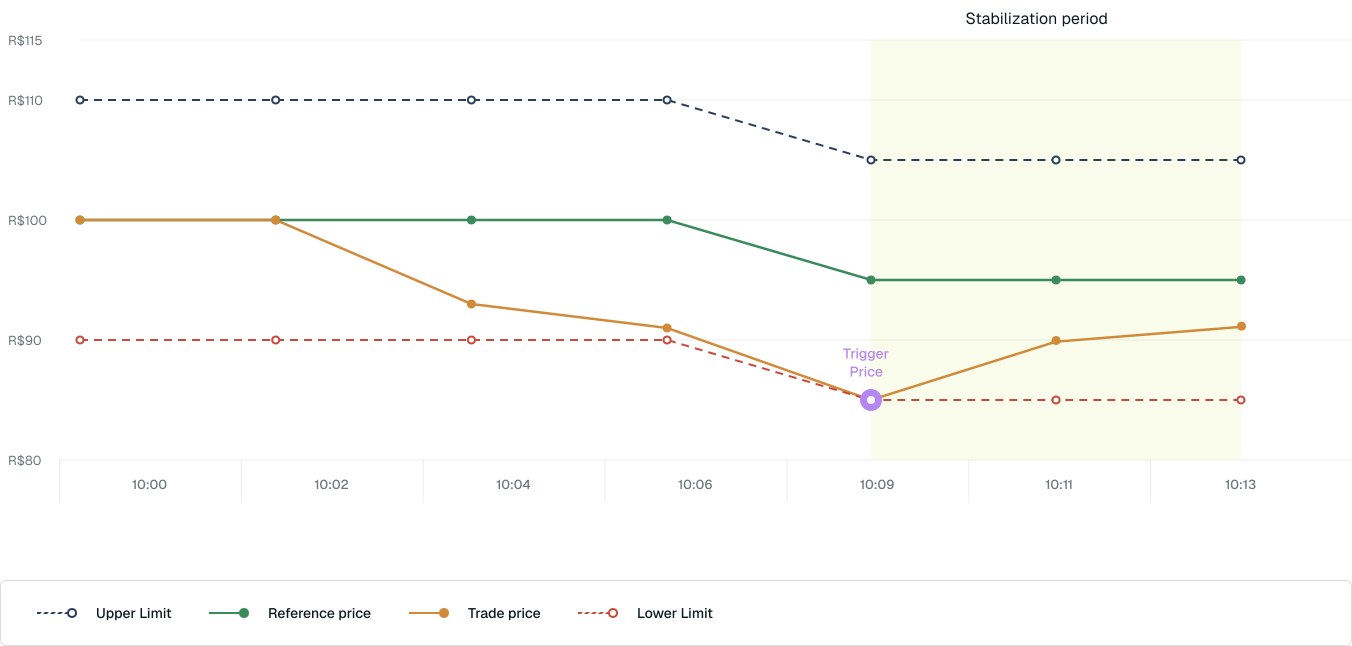
The Volatility Control Mechanism (VCM) limits sharp price movements without interrupting continuous trading. Base sets a volatility percentage and a reference price for each asset or group of assets, creating a dynamic price band. Orders that would result in a trade outside the band are rejected and trigger a five-minute stabilization period, during which the limits are frozen. Throughout stabilization, order entry, modification, and cancellation remain available, and trades execute normally within the band.
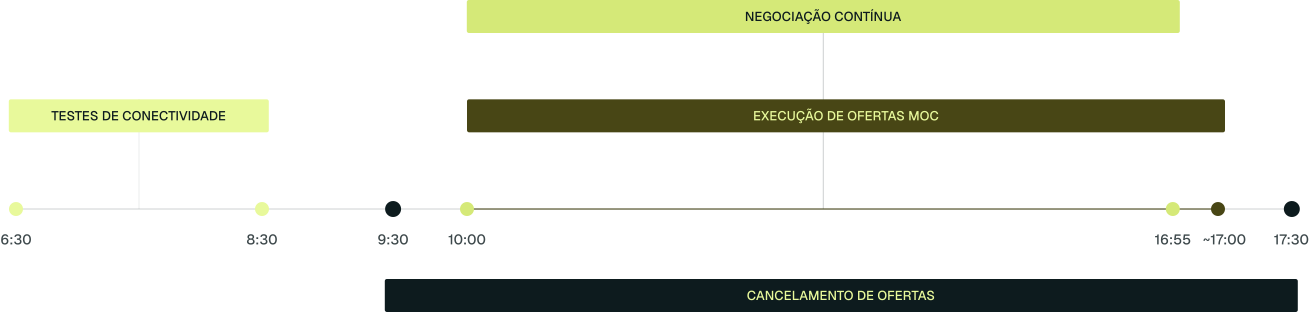
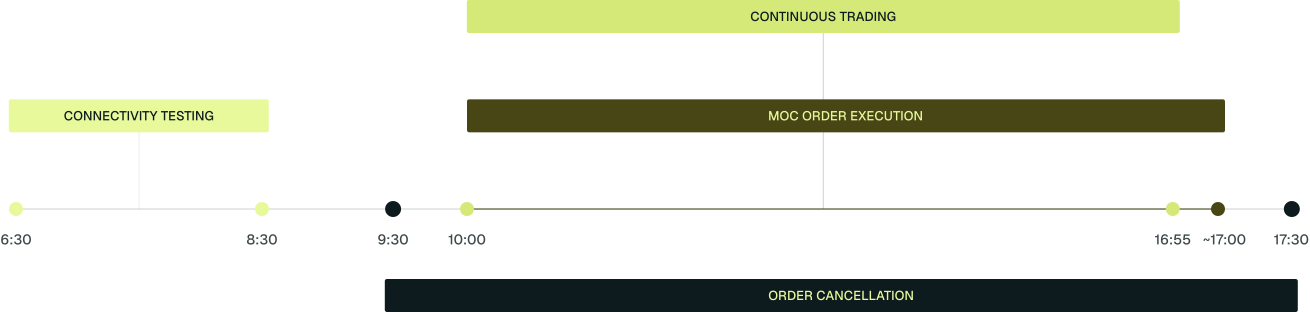
Trading hours
All times in BRT (UTC-3)
View as:
Connectivity test
6:30 AM - 8:30 AM
Continuous Trading
10:00 AM - 4:55 PM
Order cancellation
9:30 AM - 5:30 PM
MOC Order Execution
4:50 PM - ~5:00 PM
Activity
Time
Connectivity test
6:30 - 8:30
Continuous Trading
10:00 - 4:55
Order cancellation
09:30 - 5:30
MOC Order Execution
10:00 - ~5:00
Trading on Base follows the primary listing market for the instruments
Order management
The Order Management platform is an operational tool designed for real-time monitoring of offers registered in the trading environment, allowing for quick action on active orders, including immediate cancellations when necessary.
The platform also provides a consolidated view of the participant's market position through aggregated reports, supporting operational control and risk management during trading.
Order Management User Manual